-
Gender-Responsive Adaptation Action: Progress in NAP processes
 Where: Canadian Pavilion
When: Friday, December 1, 4–5 p.m. Dubai time
Host: NAP Global NetworkThe Paris Agreement acknowledges the need for adaptation action to be gender-responsive, recognizing gender differences in adaptation needs and capacities, ensuring equitable participation and influence in decision making, and achieving gender-equitable distribution of benefits resulting from adaptation investments, including finance
This session will provide an update on the progress made in mainstreaming gender considerations into NAP processes globally. It will also showcase the efforts of three francophone countries supported by the NAP Global Network—Côte d’Ivoire, Haiti, and Senegal—to address gender inequalities through adaptation action.
Government representatives from the three countries will participate in a panel discussion to highlight progress, discuss challenges, and share learning from the process. This event will be held in French, with simultaneous interpretation in English.
-
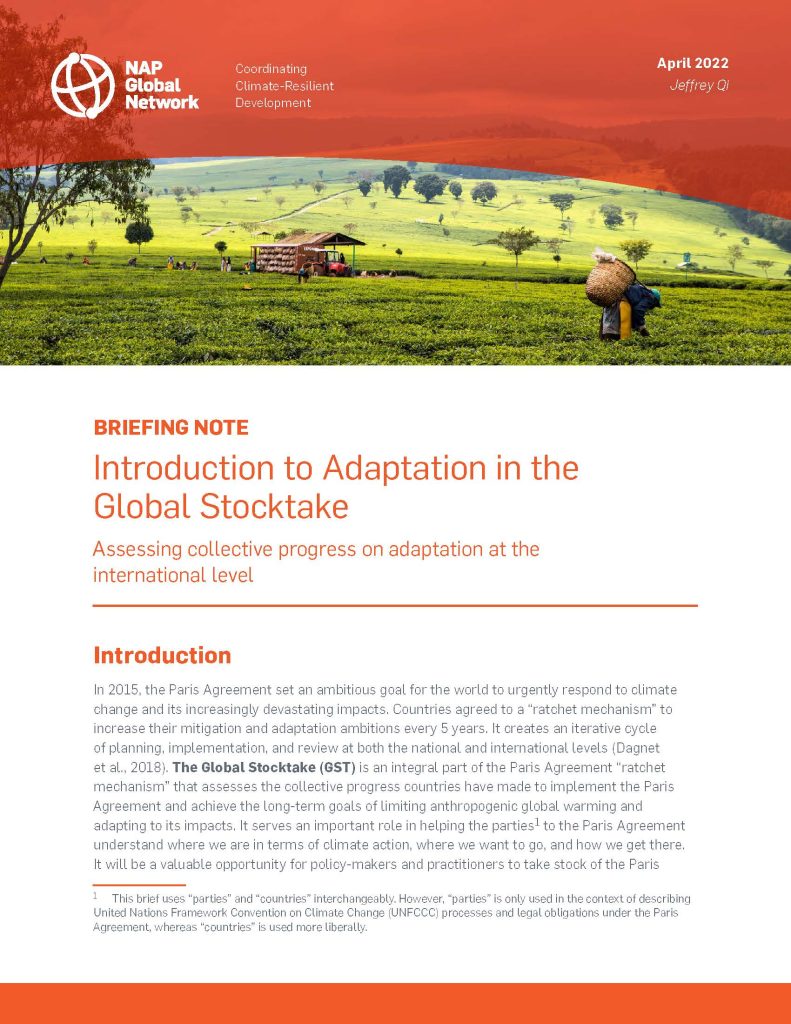
Strategic Communications for NAP Implementation: Lessons from three francophone countries
 Where: Madagascar Pavilion
When: Friday, December 1, 11 a.m. – 12 p.m. Dubai time
Host: NAP Global NetworkA strategic approach to communications is critical for governments to further engage stakeholders and civil society in the implementation of their NAPs.
This session will feature the experiences of three francophone countries—Central African Republic, Haiti, and Madagascar—in disseminating and promoting their NAP documents by using creative and strategic approaches to craft engaging key messages and target audiences through diverse channels. This event will be held in French.
-
Accelerating Impact: Implementing learning in climate change adaptation policy
 When: Saturday, December 2, 1:15–2:30 p.m. Dubai time (UTC +4)
Where: The Commonwealth Pavilion
Host: NAP Global Network, UNDPThe Paris Agreement emphasizes learning and ambition through initiatives like the Global Stocktake and the Global Goal on Adaptation. These should bolster national monitoring, evaluation, and learning (MEL) systems that influence global objectives and align with national plans like NAPs and NDCs. However, learning is frequently sidelined in policy and MEL cycles. Active efforts are required to foster learning in national policies, and sharing notable examples is crucial.
This panel will bring together governments from Commonwealth countries—including Belize and Fiji—to examine what governments and other actors have learned from implementing climate adaptation in the context of NAP processes, the factors that drove or contributed to learning, and challenges in knowledge.
-
A Strategic Imperative: Advancing climate-sensitive peacebuilding
 When: Sunday, December 3, 9:45–10:45 a.m. Dubai time (UTC +4)
Where: U.S. Center
Hosts: NAP Global Network, U.S. Bureau of Conflict & Stabilization Operations, U.S. Department of DefenseMany of the world’s most fragile and conflict-affected countries are in regions most vulnerable to the impacts of climate change.
This event will examine opportunities for aligning peacebuilding and adaptation objectives, highlighting perspectives from countries and development agencies, like the United States Agency for International Development, who are confronting these twin challenges on the ground. Discussions will focus on moving beyond rhetoric, speaking to the practicalities of integrating conflict sensitivity and peacebuilding into adaptation efforts.
-
Using Progress Reporting to Advance Your NAP: How countries track and assess progress
 When: Sunday, December 3, 3:30–4:30 p.m. Dubai Time (UTC +4)
Where: Vietnam Pavilion
Hosts: NAP Global Network, Viet Nam Department of Climate ChangeAs a medium- to long-term response to the climate crisis and to enhance adaptation action, many countries are developing and implementing NAPs and designing monitoring, evaluation, and learning (MEL) systems. However, despite the urgent need to see results and understand the progress made on adaptation, few countries currently track and report on their NAP implementation. Progress reporting is a critical element of the NAP process that helps facilitate both its regular tracking and the continuous enhancement of adaptation planning and implementation.
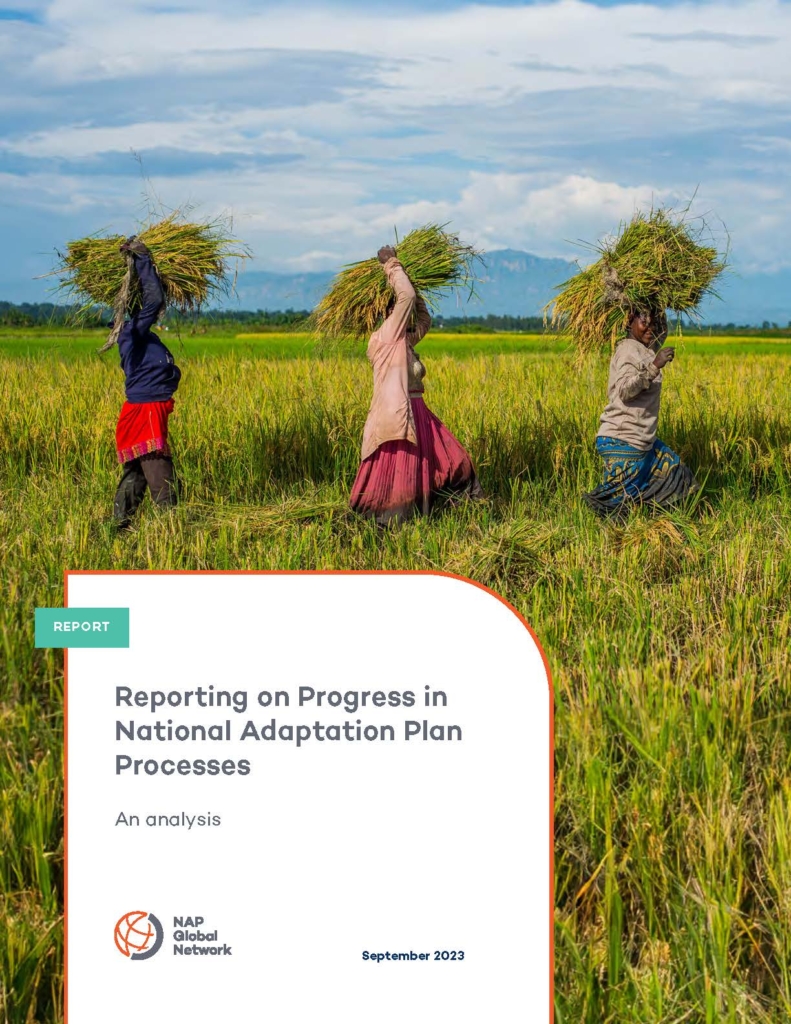
This event will launch a new NAP Global Network report that explores various approaches to NAP implementation, assessment, and reporting by countries worldwide. Discussions will shed light on the different systems and contexts in which progress reporting has been made to inspire and inform stakeholders about the importance of assessing progress, highlighting experiences from Vietnam, Tonga, and the United Kingdom.
-
Sub-national Governments’ Leadership in Driving NAP and NDC Implementation
 When: Wednesday, December 6, 11:30 a.m.–12:30 p.m. Dubai time (UTC +4)
Where: Multilevel Action and Urbanisation Pavilion
Hosts: Under2 Coalition, Regions4, NAP Global Network, and the European Committee of the Regions, in partnership with Deutsche Gesellschaft für Internationale Zusammenarbeit, the Race to Zero, Race to Resilience, and the Local Governments and Municipal AuthorityThis event aims to demonstrate the role of states, regions, cities and other non-state actors in driving progress on climate change mitigation and adaptation and enabling the integration of global agendas at the local and regional levels, particularly regarding nature-based solutions, vulnerable communities’ inclusion, and urban–rural connections.
The session will also highlight experiences of multilevel governance and collaborations among local, regional, and national governments on the definition and implementation of climate agendas such as NDCs and NAPs.
-
Development & Climate Days: Accountability
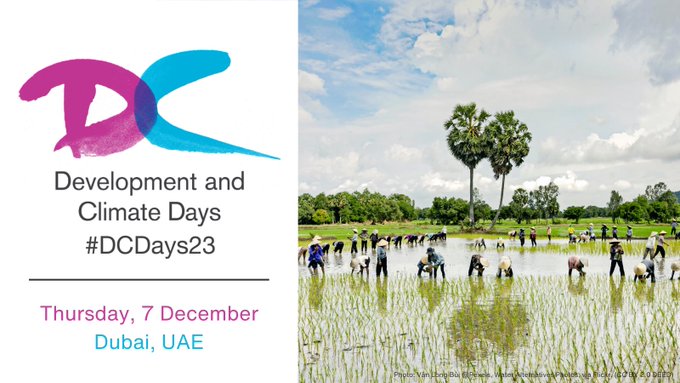 When: Thursday, December 7, 9 a.m.–7 p.m. Dubai time (UTC +4)
Where: Sofitel Dubai Downtown
Host: International Institute for Environment and Development
As economic disparities rooted in colonial histories persist, powerful companies in sectors like finance and energy still dictate the course of climate action.
Development & Climate Days 2023 will examine how actors across governments, the private sector, philanthropies, civil society organizations, businesses, and academia can be held accountable to take positive steps within their organizations to address climate impacts and reduce the risk and vulnerability of those most affected by the climate crisis. Discussions will address uncomfortable truths, tackle big questions, seek effective and practical answers, and work together on fair solutions that leave no one behind.
The NAP Global Network will host the session called How Can Monitoring, Evaluation, and Learning for Adaptation Advance Accountability When Operationalizing the Global Goal on Adaptation? This session will explore approaches that a different set of actors are using to get involved and increase accountability through the MEL system for NAP processes, and how these can be leveraged, adopted, and scaled up when operationalizing the GGA following COP 28.
-
What Skills and Capacities Are Needed at Sub-national Levels to Implement NAPs? Lessons learned from national and local-level actors
 When: Sunday, December 10, 16:25–17:25 Dubai time (UTC +4)
Where: 5th Capacity-building Hub
Hosts: Paris Committee on Capacity-building, NAP Global Network
Livestreaming: bit.ly/cop28-capacity-buildingCapacity building at the sub-national and local levels is critical to achieving a NAP process aligned with development priorities and plans and effectively channelling resources to the people, places, and systems that need them most.
This event will examine the importance of sub-national and local-level engagement in national adaptation policies and plans, discussing how capacities and networks can be enhanced to enable vertical integration in decision-making and ensure inclusive and gender-responsive adaptation action.
The session will also highlight good practices on how capacity building at sub-national and local levels can be scaled up at the national level. It will also identify country support needs to advance capacity building for vertical integration and opportunities for technical and financial support to strengthen these efforts.
-
Monitoring, Evaluation, and Learning for Adaptation: Interactive feedback session on new toolkit
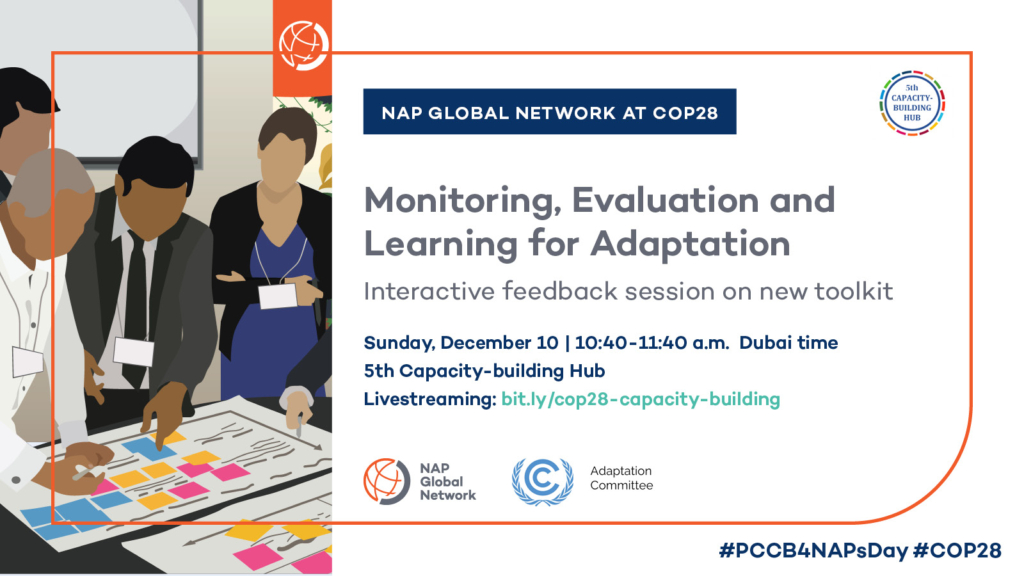 When: Sunday, December 10, 10:40–11:40 Dubai time (UTC +4)
Where: 5th Capacity-building Hub, PCCB4NAPs Day
Hosts: Adaptation Committee, PCCB, NAP Global Network, Regions4
Livestreaming: bit.ly/cop28-capacity-buildingStrengthening countries’ efforts on MEL for NAP processes with the tools and capacity to improve their national systems offers an important avenue for better assessing and enhancing the effectiveness of their adaptation actions.
This event will discuss the findings of a recently published technical paper by the Adaptation Committee on Monitoring and Evaluation of Adaptation at the National and Subnational Levels, as well as introduce the work-in-progress toolkit for MEL of National Adaptation Planning Processes being prepared by the NAP Global Network and the United Nations Framework Convention on Climate Change Adaptation Committee. Through interactive modalities, audience members will have the opportunity to provide their feedback on both studies.
-
Making NAPs More Efficient: New solutions to bridge the NAP-gap
 When: Monday, December 11, 3–4:30 p.m. Dubai time (UTC +4)
Where: Side Event Room 9
Hosts: Deutsche Gesellschaft für Internationale Zusammenarbeit; IISD/NAP Global Network, BBC Media Action, University of Twente, Green Growth Institute, Urban Climate Change Research Network/Columbia UniversityExtreme weather events, such as droughts, floods, rising sea levels, rising temperatures, and increasing water scarcity, endanger previous development successes and the achievement of the Sustainable Development Goals. NAP processes are an internationally recognized instrument built on climate risk analyses to identify, prioritize, implement, and track progress toward adaptation actions to reduce vulnerability to climate risks.
This event will highlight best practices and identify gaps toward effective, inclusive, and ambitious NAP processes. It aims to provide new perspectives to support least developed countries and Small Island Developing States in preparing their plans, including their operational and financial components.
-
Scaling Up Locally Led Adaptation Through National Action
 When: Tuesday, December 12, 12:30–1:30 p.m. Dubai time (UTC +4)
Where: NDC Partnership Pavilion
Hosts: NAP Global Network (IISD), World Resources Institute, Government of HondurasTo scale up adaptation action, countries must make intentional strategic links between locally led adaptation and the ambitions set out for adaptation at the national level. This event will explore how countries use multilevel governance to link sub-national and national adaptation action in NDCs and NAPs.
The session will highlight approaches to establishing effective local–national linkages in adaptation planning, implementation, and MEL, as well as examples of countries making meaningful progress in building strong links from the local to national levels of governance processes. It will also discuss country support needs on vertical integration for adaptation.
The 28th UN Climate Change Conference (COP 28) will bring together representatives from nearly 200 countries in Dubai, United Arab Emirates, from November 30 to December 12, 2023.
The conference will be a significant milestone in assessing the global progress in achieving the Paris Agreement’s goals on adaptation and mitigation. At COP 28, the 2-year process to prepare the first-ever Global Stocktake (GST) will conclude. Its outcomes are expected to include feasible solutions for scaling up ambitions in national adaptation plans (NAPs) and nationally determined contributions (NDCs).
The conference will also be pivotal for the discussions on the Global Goal on Adaptation (GGA), established in 2015 to enhance adaptive capacity and resilience while reducing climate change vulnerability. Participants will take stock of the progress made toward the GGA, including proposals for its frameworks, methods, and metrics, with the overarching goal of operationalizing the GGA.
The NAP Global Network Secretariat team will be in Dubai to connect with our country partners, exploring insights and lessons on NAP processes, engaging in discussions around the GST and the GGA, and tracking what adaptation-related negotiations will mean for NAP processes in years to come.
The NAP Global Network’s engagements at COP 28 will focus on
- vertical integration in the NAP process
- monitoring, evaluation, and learning of the NAP process
- peace, conflict, and NAP processes
- gender-responsive and socially inclusive NAP processes
Discover the latest information and trends in National Adaptation Plans (NAPs).
Schedule of events
Events featuring NAP Global Network representatives as panelists
-
UNEP Adaptation Gap Report 2023
When: Friday, December 1, 2023
Where: EU PavilionThe Adaptation Gap Report series aims to support decision-making at global and national levels by answering three key questions regarding the global process of adapting to climate change: What are we doing today to adapt? To what extent are we currently reducing climate risks? To what extent will our adaptation trajectory help us reduce future climate risks?
To do this, the report series provides annual global assessments of progress within three central elements of the global adaptation process: planning, finance, and implementation. In addition to the report’s core offering, the 2023 iteration of the report will also provide an assessment of adaptation finance gaps, and the loss and damage. The Adaptation Gap Report is co-produced with UNEP, UNEP-Copenhagen Climate Center (UNEP-CCC) and the World Adaptation Science Programme (WASP), which is led by UNEP, WMO, UNFCCC, IPCC, GCF, GEF and UNU.
This event features key findings from the Adaptation Gap Report 2023. Discussions will follow the presentation and focus on the importance to increase adaptation effectiveness, while assessing progress in global adaptation efforts, reducing loss, and evaluating the current adaptation finance gap.
-
Adaptation Investment Planning
When: Saturday, December 2, 3–4:30 p.m. Dubai time (UTC +4)
Where: ADB Pavilion
Host: Asian Development BankAdverse impacts of climate change are posing serious and growing threats to inclusive sustainable socio-economic development and undermining progress in poverty reduction in Asia and the Pacific region. This underscores the urgency of scaling up investments in climate adaptation and resilience. Recent years have witnessed significant progress by countries in Asia and the Pacific region in preparing the National Adaptation Plans (NAPs). However, the question is how do we ensure the adaptation priorities identified in these plans are able to secure financing and are implemented on the round? This would require bridging the gap between adaptation planning and financing.
The session will provide a venue for countries to share experiences on implementation of their NAPs and directions being taken towards developing adaptation investment plans. It will also provide an opportunity to discuss the challenges and opportunities in pursuing adaptation planning and the wider enabling environment needed in countries and within the wider global climate finance architecture for sustainable outcomes.
-
Launch of the Regional Goal on Adaptation
When: Friday, December 8, 2–3 p.m. Dubai time (UTC +4)
Where: CARICOM Pavilion
Host: Climate AnalyticsAt the COP28 launch of the proposal for a Regional Goal on Adaptation, Climate Analytics Caribbean looks forward to furthering our goal of addressing the gap between global advocacy on climate change, and driving regional and domestic climate action. Central to achieving this is the advancement of climate science, policy research and analysis and support for the right of equitable public participation in decision-making.
This event will engage Caribbean leaders and policy makers on the proposal for a Regional Goal on Adaptation and will kick off the endorsement process by Caribbean governments to formally adopt a Regional Goal on Adaptation for the region.
-
Local Governments, Global Stocktake
When: Sunday, December 10, 1:30 p.m. Dubai time (UTC +4)
Where: Bangladesh Pavilion
Host: Global Center on AdaptationWhat do local governments have to do with a Global Stocktake of progress on the Paris Agreement?
COP28 will conclude the first Global Stocktake of collective progress in implementing the Paris Agreement since its adoption in 2015. It will result in a political outcome at COP28, summarizing key political messages, opportunities, good practices, and challenges to enhance climate action and support, to help governments prepare more ambitious national climate action plans, due in 2025.
Local governments clearly have a central role to play in transformational adaptation, by ensuring that:
- Adaptation is informed and driven by local contexts, populations and priorities
- Enabling environments are created for adaptation to be transformative and effective
- There is space for experiential and niche learning
- A common vision exists, that is shared by government and non-government stakeholders, and aligned with their strategic priorities
- Strong bottom-up governance is grounded in local contexts
- Phased long-term program support and appropriate financing is available
This event at COP28 will bring together local government representatives to discuss the extent to which they are prepared to take on the challenge of transformative adaptation and the support they need to make this happen.
-
How to Increase Adaptation Effectiveness to Reduce Loss and Damage: Insights from the UNEP Adaptation Gap Report 2023
When: Tuesday, December 5, 2023
Where: Action Arena – Al Wakri, Zone B7
UNEP’s annual Adaptation Gap Report is indicating the need for increased action to reduce vulnerability and build resilience. However, progress in adaptation is slowing. Hence, the planning, implementation, and finance gaps in adaptation keep widening and leading to more losses and damages.
This UNFCCC mandated UNEP event features high-level opening remarks from UNEP’s Executive Director and UNFCCC’s Executive Secretary and a presentation of the key findings of the UNEP Adaptation Gap Report 2023.
This is followed by a panel discussion focusing on the importance of increasing adaptation effectiveness, while assessing progress in global adaptation efforts, reducing loss and damage, and evaluating the current adaptation finance gap.
An increase in adaptation effectiveness and adaptation finance is at the heart of the discussions necessary to bridge the science-policy-action gap, particularly with a need to inform the Global Stocktake, the Global Goal on Adaptation, and the deliberations on the loss and damage fund and funding arrangements.
Related Resources
-
Vertical integration in the NAP process
- Progress on Vertical Integration in National Adaptation Plan Processes: Analysis of strategic linkages between national and sub-national levels
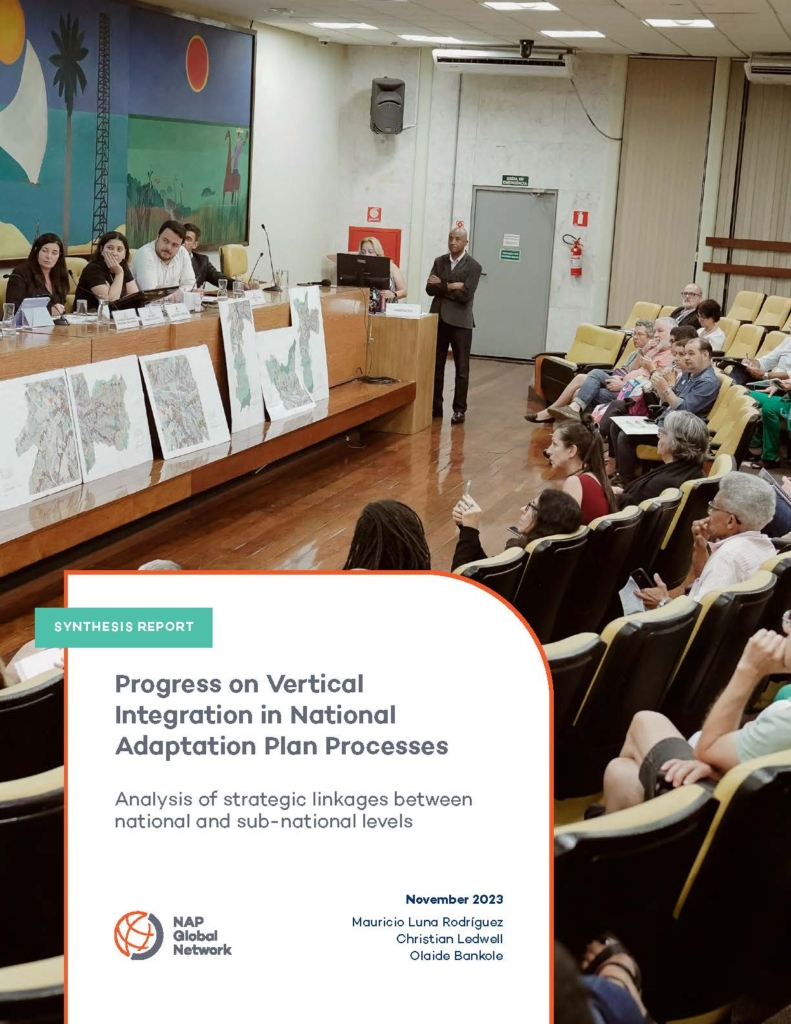
- Briefing Note | Progress and Challenges in Achieving Vertical Integration in Adaptation Processes
- Guidance note | Vertical Integration in National Adaptation Plan (NAP) Processes: A guidance note for linking national and sub-national adaptation
- Progress on Vertical Integration in National Adaptation Plan Processes: Analysis of strategic linkages between national and sub-national levels
-
Monitoring, Evaluation, and Learning
-
Peace, conflict, and NAP processes
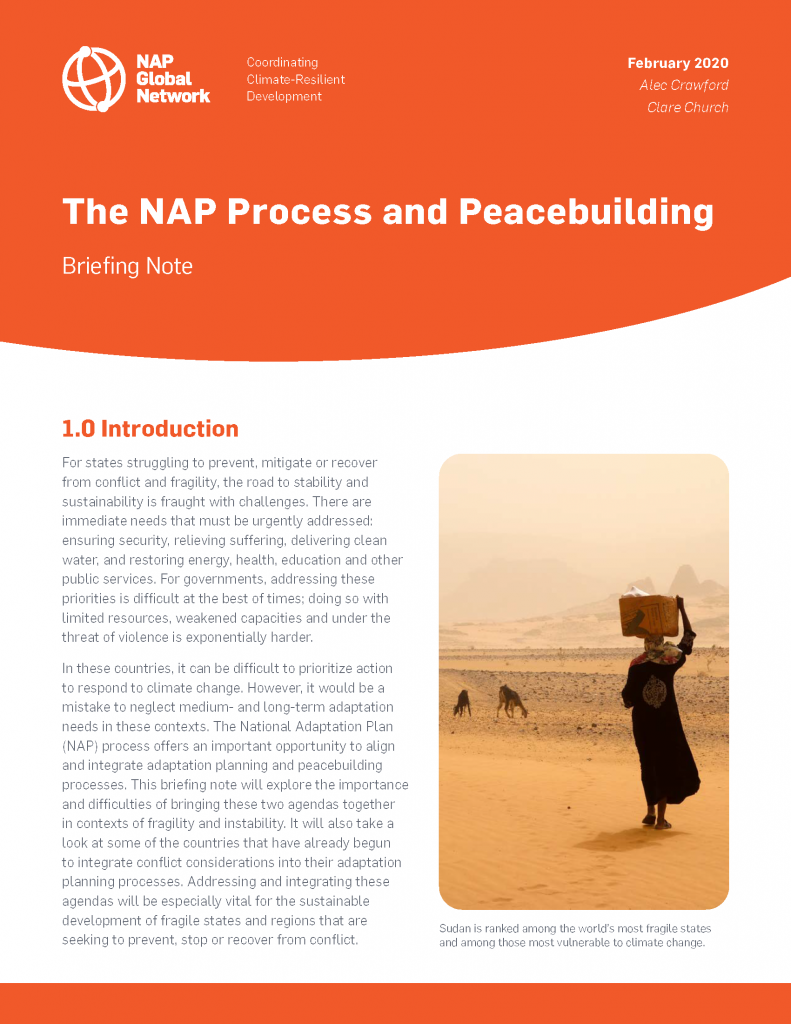 News article | Maintaining Peace While Building Climate Resilience: Lessons from the Central African Republic
- Briefing Note | The NAP Process and Peacebuilding
- Blog | Building Peace and Climate Resilience: Aligning peacebuilding and climate adaptation in fragile states
- Blog | Can You Build Peace and Adapt to Climate Change at the Same Time?
- Blog | Climate Security and Peacebuilding in a Time of Converging Crises
-
Gender-responsive and socially inclusive NAP processes
- Maximizing the Impacts of Targeted Gender Analyses for the National Adaptation Plan Process
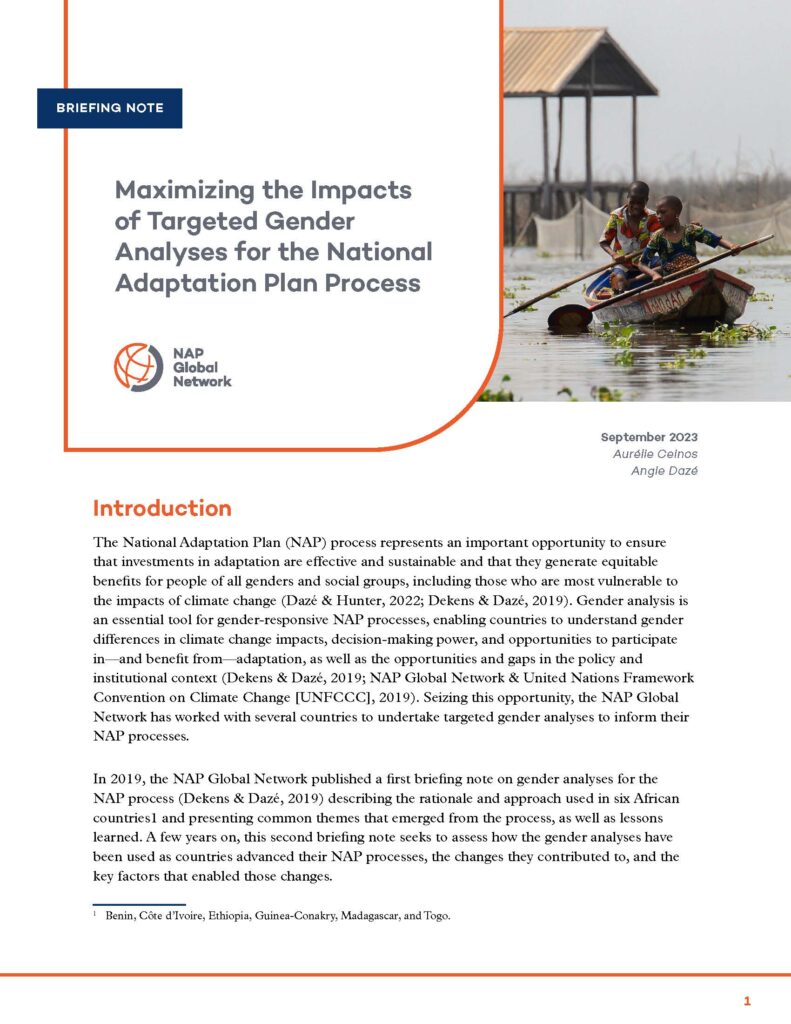
- Gender-Responsive National Adaptation Plan (NAP) Processes: Progress and promising examples
- Video | Why Gender Matters for Effective Adaptation to Climate Change
- Infographics | Gender Mainstreaming in Climate Action in Côte d’Ivoire
- Maximizing the Impacts of Targeted Gender Analyses for the National Adaptation Plan Process
-
Progress reporting in NAP process
-
Strategic Communications for NAP Implementation
Contact
For more information on the NAP Global Network’s activities and engagements, contact the Secretariat team at info@napglobalnetwork.org.
For media enquiries, please contact Communications Manager Juliet Perry at jperry@iisd.org, or Senior Communications Officer Cesar Henrique Arrais at chenriquearrais@iisd.ca. Join a network of adaptation decision-makers and practitioners from developing countries working on National Adaptation Plan (NAP) processes to:
- Receive the NAP Global Network’s monthly newsletter with news and useful resources
- Apply for technical support opportunities
- Take part in peer exchanges.