As the adverse impacts of climate change on communities and the economy become more evident, there is an urgent need for countries to efficiently mobilize finance and accelerate the implementation of their priority adaptation measures to manage these risks and promote sustainable development in a changing climate.
The Global Goal on Adaptation (GGA), introduced as a collective commitment by the Paris Agreement in 2015, provides countries with a framework to drive adaptation action and support. The GGA implementation target states that by 2030, “All Parties have progressed in implementing their national adaptation plans, policies, and strategies, and have reduced the social and economic impacts of key climate hazards” (UNFCCC, 2023). However, the existing adaptation implementation gap—the number of identified but not yet implemented adaptation priorities—is significant. According to the latest UNEP Adaptation Gap Report, despite the increasing need for adaptation, progress in planning and implementing adaptation actions is plateauing, primarily due to insufficient financing and investment.
Although the New Collective Quantified Goal (NCQG) on Climate Finance set at COP29 in Baku aims for $300 billion annually by 2035—significantly raising the previous target of $100 billion per year—and intends for at least 50% of the total climate finance to be allocated to adaptation efforts, this new goal still falls far short of the global adaptation finance gap, which is estimated to range from $194 billion to $366 billion.
Financing adaptation is challenging due to uncertainties associated with future climate risks, difficulties in measuring the return on investment of adaptation options, limited funding availability—which often forces adaptation to compete with other development priorities—and the lack of a coordinated, programmatic approach to accessing adaptation finance, with ad hoc, project-based approaches being the norm.
To bridge the global adaptation financing gap, it is crucial to access a diverse array of funding sources, including domestic, international, public and private sources, and financing instruments. Climate change adaptation investment planning offers a structured approach to unlock these financial resources and accelerate the transition towards implementing the countries’ adaptation priorities.
Specifically, adaptation investment planning is a strategic, and structured approach to mobilizing finance for adaptation, leading to the development of a climate change adaptation investment plan (CCAIP).
In this article, we answer the following frequently asked questions about adaptation investment planning:
- What is a climate change adaptation investment plan?
- What are the sources of finance and types of financial instruments that should be considered in an adaptation investment plan?
- How can countries increase domestic resource mobilization as part of adaptation investment planning?
- What international sources of finance can countries access for climate change adaptation investment plans?
- How can the private sector be engaged as a source of funding for adaptation investment plans?
- What types of financial instruments can countries use to fund priorities in their adaptation investment plans?
- What is the link to the NAP process?
- What are the factors enabling climate change adaptation investment planning?
- How can gender and social inclusion (GESI) be integrated into an adaptation investment plan?
- What are the main differences between a NAP financing strategy and an adaptation investment plan?
What is a climate change adaptation investment plan?

-
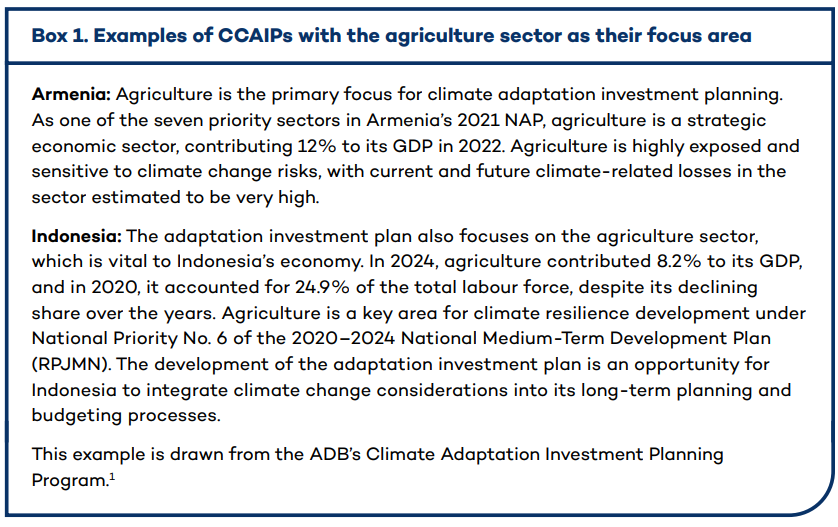
Narrowing down and selecting the sector, geographic region, etc. to define the adaptation investment plan’s focus.
This selection is based on various criteria that should be defined by the country. It can include the country’s context, sectors’ or geographic regions’ level of sensitivity to climate change, and sectors’ or regions’ importance in relation to the national development and economic strategies, among others. Countries with a NAP document may start with priority sectors and regions identified in the NAP.
¹ S. M. Gonzales, Asian Development Bank (ADB), personal communication, March 13, 2025.
-
Assessing climate risks and identifying and prioritizing adaptation investments.
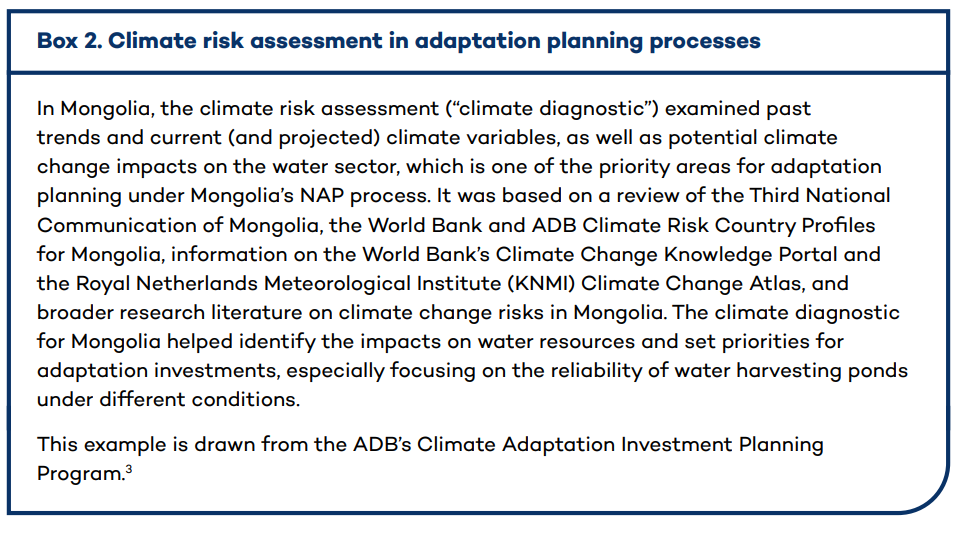
Priority adaptation investments are typically “packages” of key adaptation activities designed to enhance the resilience of the selected sector or geographic region of focus. This typically starts with a detailed assessment of key climate risks that might hinder the achievement of the development goals in a sector or geographic region, and the identification of the most suitable adaptation activities.
The identified adaptation activities are then prioritized based on different criteria, such as their contribution to climate resilience, gender equality, social inclusion, biodiversity benefits, alignment with national and sectoral priorities, and the availability of existing technologies and skills.
If a country has a NAP document, it will have outlined key climate risks and identified a set of adaptation priorities. However, even if these steps of climate risk assessment, identification of relevant adaptation options, and prioritization were already completed for the NAP, they may need to be repeated for adaptation investment planning. This is because adaptation investment planning requires a level of granularity and detail that is often not provided in NAPs.
This activity results in a list of priority adaptation investments, which can be bundled into adaptation investment packages to facilitate resource mobilization and the use of specific financial instruments.
Engaging a broad range of actors, such as government agencies, representatives from the private sector, financial institutions, civil society organizations, academia, local communities, and international organizations, is crucial to ensure that the selected adaptation investment packages are relevant, widely supported, and generate equitable outcomes. Given that countries already have engagement processes underway for the NAP process, it’s important to be mindful of the effort required for the development of a climate change adaptation investment plan.
When countries have a highly participatory NAP process, and there’s confidence that the adaptation priorities are representative and will yield equitable outcomes, less broad engagement will be needed for the CCAIP process. However, if the NAP process is less participatory, more engagement will be necessary for developing the CCAIPs. Therefore, it’s crucial to first understand which actors have been involved in the NAP process, how they were engaged, and the extent of their influence on the process. This understanding will help determine the appropriate engagement strategy for the CCAIP process.
² Examples of investment packages could include hard infrastructure projects, such as the construction of water reservoirs, combined with soft measures like establishing early-warning systems, promoting water-saving technologies, educating communities about water conservation and efficient use, training local stakeholders and water managers on best practices for water management and adaptation strategies, and developing and enforcing policies that encourage sustainable water use.
³ S. M. Gonzales, ADB, personal communication, March 13, 2025.
-
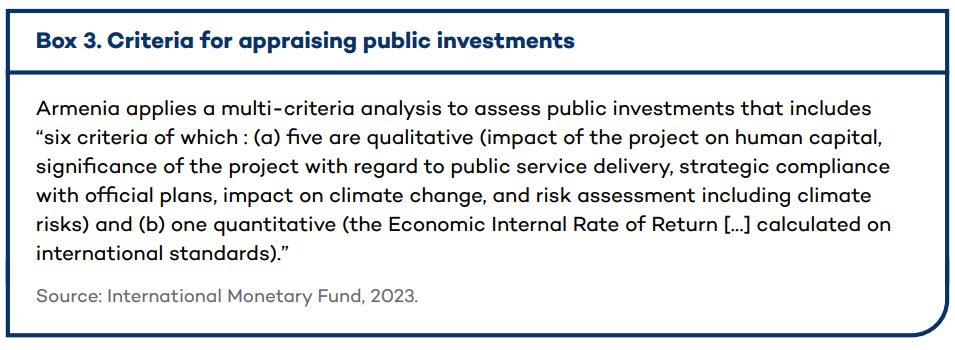
Appraising the priority adaptation investment packages to demonstrate their economic and financial viability as well as their adaptation benefits
—ideally using the same criteria that countries apply to assess public investments (see Box 3 for an example). This will help leverage domestic financial resources and facilitate the integration of adaptation investment packages into the public investment management and budgeting systems, thereby increasing their likelihood of being implemented.
Costing adaptation priorities⁴ is also a crucial step in the elaboration of the climate change adaptation investment plan. It enables efficient resource allocation, informed decision making, and strategic financial planning. Accurate cost estimates help appraise adaptation options, ensure transparency, and build trust among key actors.
⁴ The NAP Global Network has developed the NAP Costing Tool, an Excel-based resource designed to help countries estimate the costs of their priority adaptation options. Some countries—such as Fiji, Pakistan, and Albania—are using the NAP costing tool to conduct detailed costing exercises (Ministry of Economy, Government of Fiji, 2020).
-
Matching the adaptation investment package with appropriate sources of finance and financing instruments.
Upon clarifying the specific suite of adaptation measures to be implemented by bundling them together into an investment package, they should be linked to an identified source of finance and the most suitable financial instrument for their implementation.
What are the sources of finance and types of financial instruments that should be considered in an adaptation investment plan?

-
How can countries increase domestic resource mobilization as part of adaptation investment planning?
Countries will need to mobilize domestic adaptation finance, as relying solely on public international funding is likely to be insufficient to ensure the implementation of their adaptation investment plans. Mapping the fiscal space for adaptation and identifying effective strategies to increase domestic resource mobilization are crucial steps here.
According to Readhead et al. (2024), different avenues are possible to effectively mobilize domestic resources for climate change adaptation, including:
- Strengthening domestic taxation can make the tax system more effective in capturing revenue from the extraction and use of natural resources like minerals, oil, gas, and timber; reviewing and reorganizing existing tax incentives can ensure they are efficient, effective, and aligned with policy goals; and, broadening the tax base through mechanisms like a value-added tax, property taxes, and potentially wealth taxes is also beneficial.
- Implementing environmental tax reforms, such as carbon taxes, and removing fossil fuel subsidies can generate revenue or save resources while promoting sustainable practices. However, these reforms must be tailored to the specific political and economic context.
- Enhancing the efficiency of public procurement processes can reduce costs and free up resources for adaptation investments.
- Developing robust domestic debt markets, supported by a strong institutional investor base, can provide steady demand for project bonds that finance sustainable infrastructure and other adaptation projects.
- Providing practical guidance on the appropriate package of measures, sequencing, and hierarchy of reforms is vital to ensure effective implementation and maximize the impact of domestic resource mobilization efforts.
It is important to recognize that some developing countries may not be in a position to prioritize these efforts to increase domestic adaptation finance. Therefore, a tailored approach that considers their unique challenges and limitations is essential when identifying the most appropriate sources of funding for climate change adaptation.
-
What international sources of finance can countries access for climate change adaptation?
Countries can access a variety of international sources of finance for adaptation. Under the UNFCCC, key sources include the Green Climate Fund, the Global Environment Facility (which administers the Least Developed Countries Fund, the Special Climate Change Fund, and the Adaptation Fund). Outside the UNFCCC, multilateral development banks, development finance institutions (e.g., the International Finance Corporation), and bilateral cooperation from countries provide significant support for climate change adaptation. These sources typically offer technical assistance and utilize diverse financial instruments, such as grants, loans, equities, or credit risk guarantees.
Countries should identify the most appropriate international sources of finance for their adaptation investment plans based on various factors, including the alignment of funding sources with the country’s adaptation priority investments, historic collaboration with potential funding sources, or the eligibility and accessibility criteria of each funding source.
-
How can the private sector be engaged as a source of funding for adaptation investment plans?
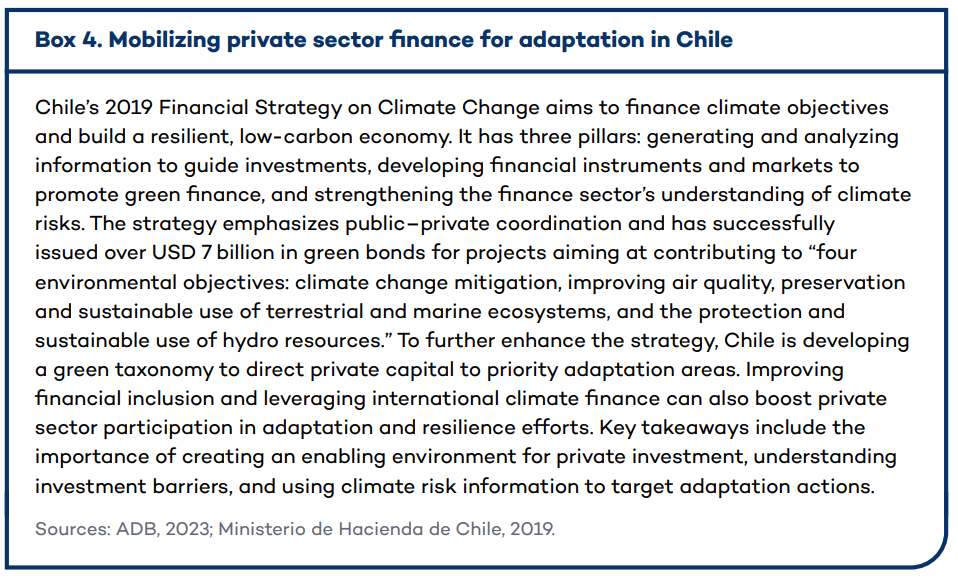
Engaging the private sector from the outset of the adaptation planning processes is crucial for ensuring its effective involvement in mobilizing finance. Key strategies include raising awareness about the importance of adaptation investments, using climate risk assessments to inform the selection of the most appropriate adaptation investments, building the case for these investments by demonstrating how they can avoid costs and generate revenue, and implementing de-risking mechanisms, such as blended finance or credit risk guarantees. Additionally, using fiscal policies and regulations can enhance private sector investments, while establishing institutional frameworks can encourage and facilitate private sector investment in adaptation (i.e., public–private partnership frameworks).
The “private sector” is diverse, encompassing micro, small, and medium-sized enterprises(MSMEs), large corporations, financial institutions, etc. Each country must understand which segment of the private sector it is targeting, identify barriers to private sector engagement in adaptation finance, and determine the most suitable approaches for these entities to invest in priority adaptation investments for the country.
-
What types of financial instruments can countries use to fund priorities in their adaptation investment plans?
Different financial instruments can be mobilized to unlock adaptation finance, including the following:
- Grants provide non-repayable funds, while concessional loans offer repayable funding with favourable terms to support large-scale adaptation projects.
- Equity involves investment in exchange for ownership stakes, aligning investor and project interests.
- Bonds, including green, climate, or resilience bonds, raise capital from investors to finance environmentally sustainable and adaptation projects.
- Debt-for-nature or debt-for-climate swaps allow countries to reduce debt in exchange for commitments to invest in conservation or climate change adaptation.
- Guarantees reduce investment risks by ensuring repayment in case of default, encouraging private sector participation. Insurance products protect against climate related losses, providing financial security and encouraging investment in resilience measures.
- Finally, blended finance combines public and private funds to leverage additional resources and reduce risks, making adaptation projects more attractive to private investors.
The NAP Global Network has created an inventory of innovative financial instruments for climate change adaptation to help bridge the gap between available financing and the needs of developing countries (Gouett et al., 2024).
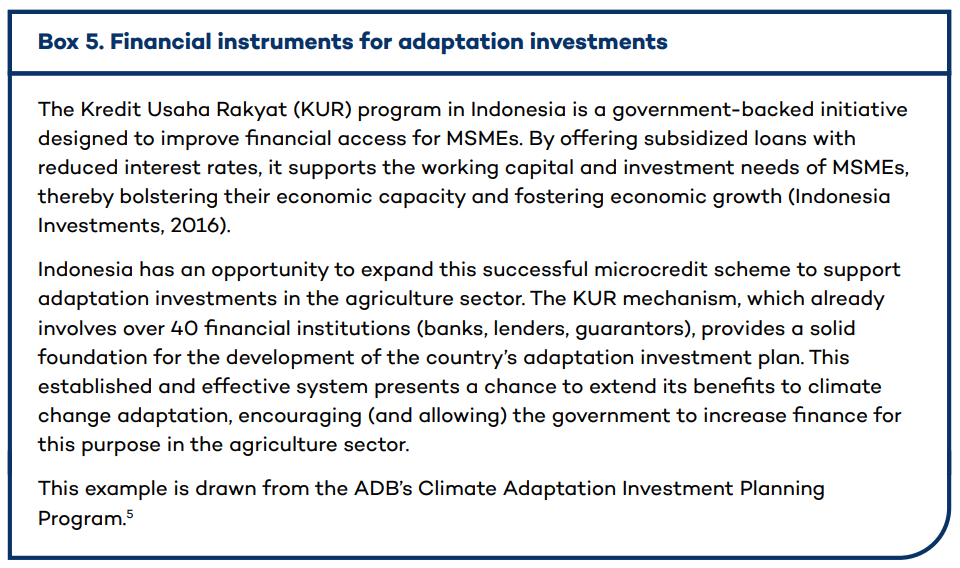
⁵ S. M. Gonzales, ADB, personal communication, March 13, 2025.
What is the link to the NAP process?
The NAP process is a strategic, country-driven process for identifying and addressing countries’ medium- and long-term adaptation priorities while mainstreaming adaptation into development planning and budgeting. For more information on the NAP process, please read our related FAQ.
The adaptation investment planning process should be part of the NAP process, allowing countries to move from articulating their adaptation priorities to implementing them in a swift, timely, and coordinated manner.
Adaptation investment planning should build on the analysis, institutional structures, and relationships that have been established and used in identifying a country’s adaptation priorities. Where a NAP document outlining these priorities has been produced as a key milestone/output of the NAP process, it should serve as the starting point for developing a climate change adaptation investment plan. Other policy frameworks like national or sectoral development strategies must be consulted to ensure that all investments are aligned with the country’s broader development goals.
In cases where a country hasn’t yet developed a NAP document, the adaptation investment plan is often developed by drawing adaptation priorities from other sources, such as a national development plan with adaptation elements, adaptation chapters of nationally determined contributions (NDCs), or sectoral strategies (and action plans). Whether the starting point is a NAP, NDC adaptation chapter, or another document, the crucial aspect is that the country has clearly identified and articulated specific adaptation priorities, and these should be the starting point for investment planning.
Again, whether a NAP document has been produced or not, the broader NAP process should be leveraged to increase efficiency in the development of climate change adaptation investment plans. The NAP process not only leads to the identification of a country’s adaptation priorities: it also provides an enabling environment for adaptation action, including adaptation investment planning. This enabling environment includes, among other things, the availability of data and information to understand and map the country’s key climate risks, skills and capacities in climate change adaptation and finance, engagement and mobilization processes, and institutional arrangements (see next section).
What are the factors enabling climate change adaptation investment planning?

-
Leadership
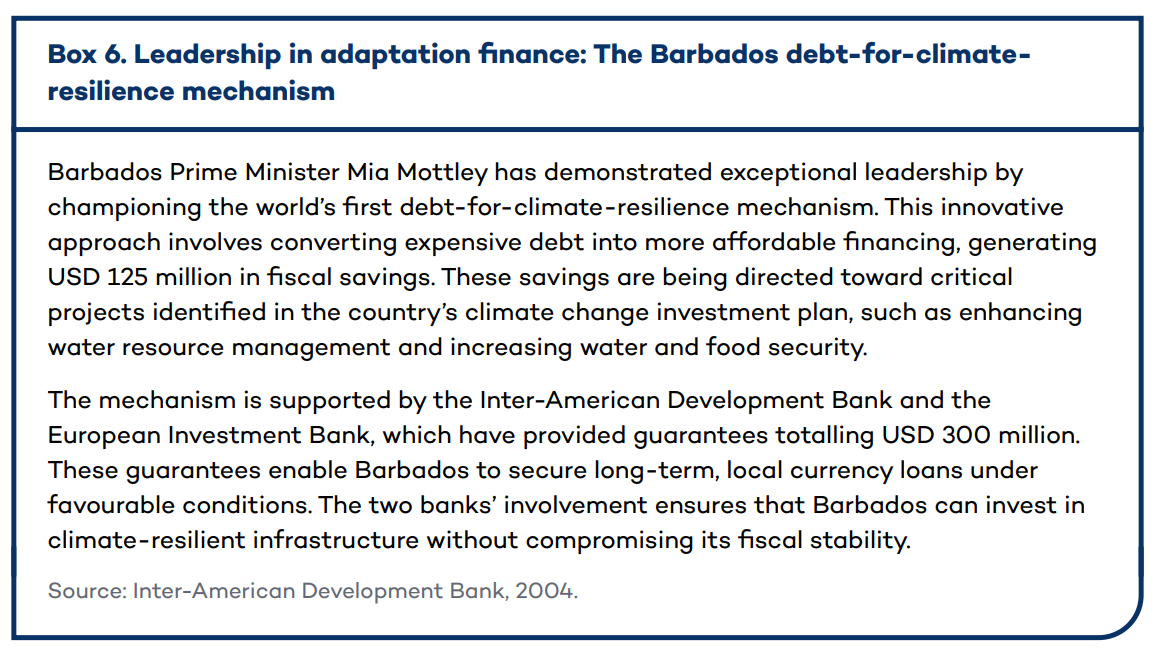
Strong political will and leadership are essential for adaptation investment planning, as active support and advocacy efforts from key leaders can help mobilize resources, drive policy reforms, and encourage collaboration to unlock adaptation finance. Support from ministries of finance is especially important. They are crucial to ensuring sufficient funds are allocated to adaptation, integrating climate considerations into broader fiscal and economic policies, assessing the impact of investment packages on economic and fiscal risks associated with climate change, and convening all relevant actors for the development and implementation of the climate change adaptation investment plan.
-
Institutional Arrangements
Institutional arrangements for adaptation investment planning involve establishing clear policies and regulatory frameworks, creating dedicated agencies or interministerial committees, and ensuring robust engagement of all relevant actors. These structures facilitate coordination across various actors and levels, enabling the systematic integration of adaptation investment packages into the country’s broader planning and budgeting systems.
Frameworks such as budget tagging and tracking systems, “green taxonomies,” and climate resilient fiscal planning mechanisms also enable adaptation investment planning processes. Equally important is incorporating climate change considerations into public investment appraisal mechanisms and ensuring the transparency and accountability of the use of the funds, through establishing clear reporting and disclosing requirements and maintaining open communication with key stakeholders.
-
Engagement
Engaging all relevant actors in a gender-responsive and socially inclusive way from the outset is crucial. This includes government actors, such as the ministry in charge of driving the NAP process, who can ensure that adaptation investment planning draws from the broader NAP process and is fully aligned with the country’s adaptation priorities. Similarly, sectoral ministries play a pivotal role in ensuring that adaptation investment packages align with sector-specific priorities for adaptation and development. The ministry in charge of gender and social inclusion can ensure the investment plan is aligned with gender and social inclusion policies and strategies and results in equitable outcomes.
Engaging non-government actors—i.e., from civil society, private sector, and academia—in climate adaptation investment planning is also key because it leverages diverse expertise, resources, and innovative solutions, enhancing the effectiveness and acceptability of climate adaptation investments.
Finally, GESI considerations must be integrated throughout the adaptation investment planning process to ensure that investments will benefit those who need them most— vulnerable people in communities on the frontlines of climate change—and to avoid inadvertently exacerbating existing inequalities (Dazé, 2020).
-
Data, Knowledge, and Communication
Developing an investment plan becomes more efficient when all necessary data and information are readily available and accessible. While the starting point is to draw from all the data and information used in the NAP process, adaptation investment planning may also need to generate new data and models, especially for more detailed climate risk assessments and economic appraisals. Effective communication is key to keeping actors informed about the process as it unfolds, providing regular updates, and maintaining key documentation accessible to all stakeholders.
-
Skills and Capacities
Enhancing existing skills and capacities of key actors to identify key climate risks, determine relevant adaptation activities, and pinpoint the most suitable sources of finance and instruments in a manner inclusive of GESI considerations, is crucial when developing climate change adaptation investment plans.
Additionally, knowledge and technology transfer are essential, particularly when adaptation activities require the use of innovative technologies that have not been previously employed by the country for climate change adaptation purposes.
How can GESI be integrated into an adaptation investment plan?
To ensure the investment plans result in gender and socially equitable outcomes, GESI should
be integrated throughout the process of developing the plan.
- Buy-in from the leaders of the process should be secured to ensure that equity is a key consideration.
- GESI actors, including experts from the ministry in charge of gender or social inclusion but also from a large range of civil society organizations such as women-led, feminist, youth, and Indigenous groups should be involved in the whole process from the outset and at critical stages, such as the selection of criteria for the appraisal and the prioritization processes as well as the revision of advanced draft(s) of the plan.
- Enhancing skills and capacities on gender-responsive and socially inclusive investment plans of the actors involved in the process is key to ensure it is considered across the process.
- During the identification and prioritization of the adaptation packages, GESI should be considered by ensuring that
- Additional risks assessments carried out are gender-responsive and socially inclusive.
- Adaptation investment packages are gender-responsive.
- Alignment with GESI policies and strategies is one of the criteria for prioritization.
- During the appraisal and matchmaking process, GESI should be considered by ensuring that
- GESI is one of the appraisal criteria.
- Funder requirements on GESI issues are reviewed.
What are the main differences between a NAP financing strategy and an adaptation investment plan?
While there is no single definition of a NAP financing strategy (or adaptation financing strategy, or resource mobilization strategy), it generally refers to a document produced during the NAP process that outlines—in broad terms—a country’s requirements and strategy for obtaining funding to implement its adaptation priorities. It can serve as a jumping-off point for developing a more detailed and focused adaptation investment plan.
The process by which a financing strategy is developed will vary from country to country but may be understood to consist of three main building blocks (Murphy, 2022; Parry et al., 2017):

-
Identifying the financing gap
Taking into account financing needs throughout the entire NAP process, countries are encouraged to determine the full extent of their expected costs. They can then determine the extent to which some of these costs are already being met through existing sources of financing, such as domestic budgets. This information can be used to determine the gap between available and needed financing for the NAP process.
-
Determining financing options
Analysis should then be undertaken to determine which sources of financing may be most appropriate to meet the financing needs of the NAP process. In making these decisions, countries should consider their existing circumstances, relationships, and capacities and consider the best financial instruments to use.
-
Identifying operational next steps
To ensure its effective implementation, a financing strategy should include a realistic and specific set of next steps. These next steps could include capacity building, informing key actors, preparing proposals, or establishing monitoring and evaluation systems. An important operational next step could include developing an adaptation investment plan. The strategy should identify which actors will be responsible for undertaking which activities. It should also include a realistic timeline with specific milestones to be reached in the near, medium, and long terms.
Both a NAP financing strategy and an adaptation investment plan aim to help countries adopt a more structured approach to adaptation finance. However, they differ in several ways, namely the following:

-
Purpose
The NAP financing strategy provides a structured approach to understanding the overall NAP financing needs and identifying potential sources of finance to bridge the country’s adaptation finance gap. It focuses on creating a comprehensive framework to secure the necessary funds for the entire NAP. The climate change adaptation investment plan primarily aims to identify a set of adaptation investments that are ready to implement, as well as specific funding sources and instruments needed for their implementation.
-
Scope
A NAP financing strategy covers the entire scope of the NAP, addressing the broader needs of the country’s adaptation efforts and, potentially, the associated costs for implementing its priorities across the full time horizon of a NAP. In contrast, the adaptation investment plan is typically narrower, focusing on specific sectors or geographic regions, and more time-bound. This targeted approach allows for a more detailed and actionable plan to pursue and secure immediate investment opportunities. Creating an adaptation investment plan for the entire NAP document may not be practical, as the detailed analysis required to identify, shape, and appropriately finance specific investment packages would be overwhelming.
-
Outcomes
The NAP financing strategy identifies the adaptation finance gap and serves as a guide for longer-term financial planning and resource mobilization. Conversely, the adaptation investment plan results in the creation of priority adaptation investment packages. These packages are detailed and ready for implementation, ensuring that the identified projects can move forward quickly.
-
Timeframe
While a NAP financing strategy typically spans a longer-term horizon and aligns with the overarching goals and timelines of the NAP, the adaptation investment plan often concentrates on the shorter term, prioritizing immediate to medium-term investments.
-
Granularity
The NAP financing strategy provides a high-level estimation of financing needs for adaptation and an exploratory identification of potential sources and instruments. This approach is more about setting the stage for future investments and alignment with long-term national development planning rather than detailing specific projects. The adaptation investment plan involves the development of concrete, investment-ready adaptation packages, including specific funding sources and instruments. This level of detail ensures that the projects are thoroughly vetted and ready for implementation and potentially aligned with annual budgets and relevant medium term socio-economic policies (as outlined in national development plans).
-
Flexibility
The financing strategy offers a flexible framework that can adjust to evolving financial landscapes and emerging needs. In contrast, the adaptation investment plan typically focuses on predefined investments with specific funding requirements within a specific timeline, making it more rigid.
-
Leadership
While the NAP financing strategy is usually led by the ministry in charge of the NAP process (typically the ministry responsible for environment and/or planning), the adaptation investment plan is usually led by the ministry of finance or the ministry of economy, reflecting its focus on immediate, actionable investments that could be easily mainstreamed into public investment management and budgeting systems.