The Basics | Content | Leveraging the NAP process
The Paris Agreement’s Enhanced Transparency Framework (ETF) for Action and Support aims to build mutual trust and confidence between Parties under the United Nations Framework Convention on Climate Change (UNFCCC). At the centre of the Paris Agreement’s ETF is the Biennial Transparency Report (BTR), which replaces both the Biennial Report and the Biennial Update Report under the UNFCCC.
Under the ETF, countries have the option to report on climate change impacts and share information on adaptation efforts. As many countries are preparing their first BTR, the NAP Global Network answers some common questions on how to prepare the adaptation chapter of the BTR (referred to as Adaptation BTR, or A-BTR) and how they can leverage the outputs and results of the National Adaptation Plan (NAP) processes.
The authors wish to thank Orville Grey, Anne Hammill, Christian Ledwell (International Institute for Sustainable Development), and Nathan Cogswell (World Resources Institute) for reviewing this FAQ.
Any opinions stated herein are those of the author(s) and do not necessarily reflect the policies or opinions of the NAP Global Network, funders or Network participants.
THE BASICS
-
What Is the ETF?
The ETF was established in 2015 with the adoption of the Paris Agreement. The ETF supersedes a portion of the previous measurement, reporting, and verification system of the UNFCCC and provides a more comprehensive reporting and review system for mitigation, adaptation, and means of implementation and support. Article 13, paragraph 1 reads:
In order to build mutual trust and confidence and to promote effective implementation, an enhanced transparency framework for action and support, with built-in flexibility which takes into account Parties’ different capacities and builds upon collective experience is hereby established.
Following the adoption of the Paris Agreement, Parties negotiated and adopted Decision 18/CMA.1 in 2018, which contains the modalities, procedures, and guidelines (MPGs) for the ETF, including the mandatory and optional elements the Parties would report in their BTRs. Subsequently, in 2021, Parties adopted Decision 5/CMA.3, which contains the outline for the BTR, as well as the common tabular formats and common reporting tables. The ETF was designed to be non-intrusive, non-punitive, and flexible while facilitating improved reporting and transparency over time.
-
What Is the BTR?
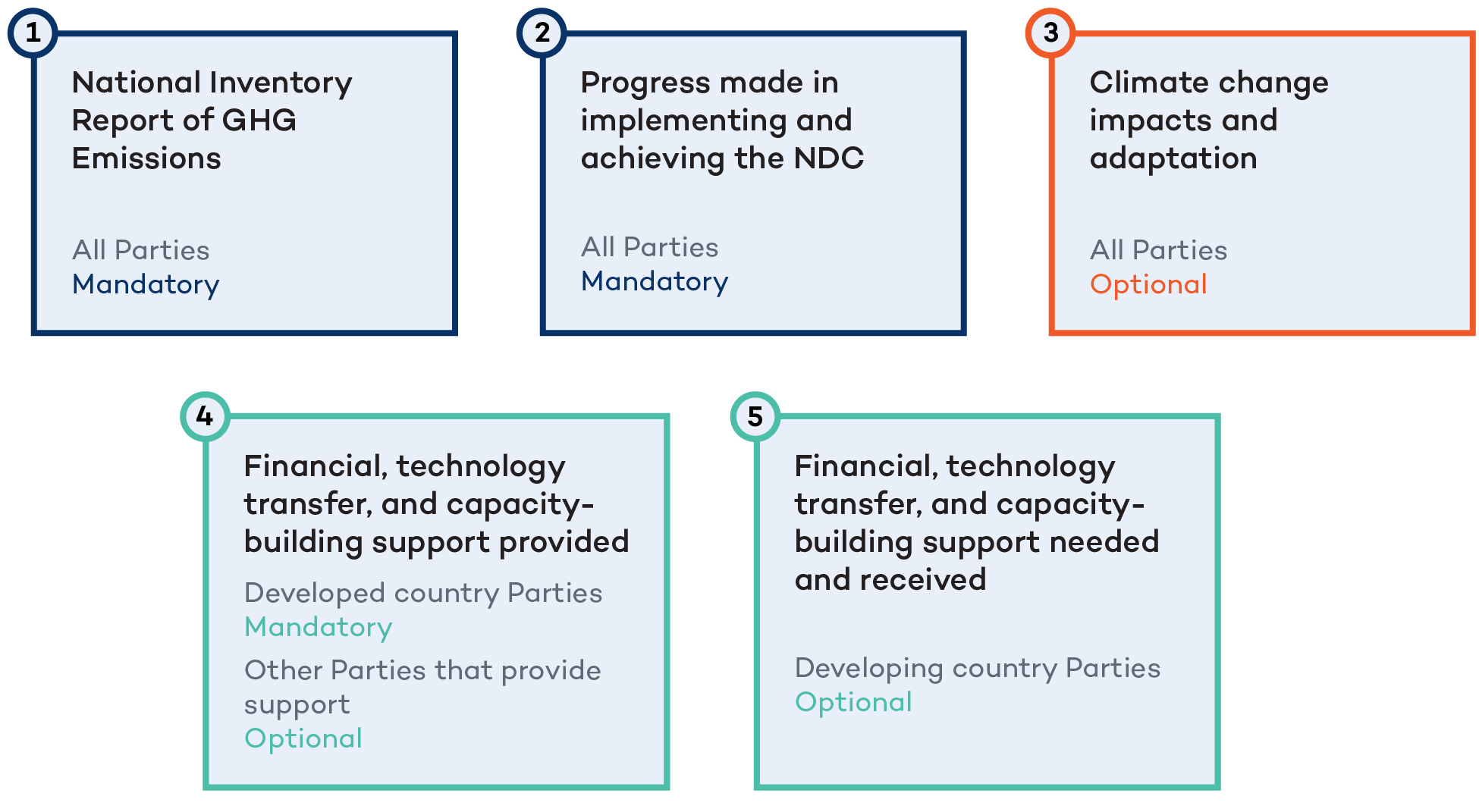
The BTR is a report prepared and submitted by Parties to the Paris Agreement that captures information on their progress in implementing the different aspects of the Agreement. The different aspects are covered in the five separate chapters of the BTR, some of which are mandatory and some of which are optional:
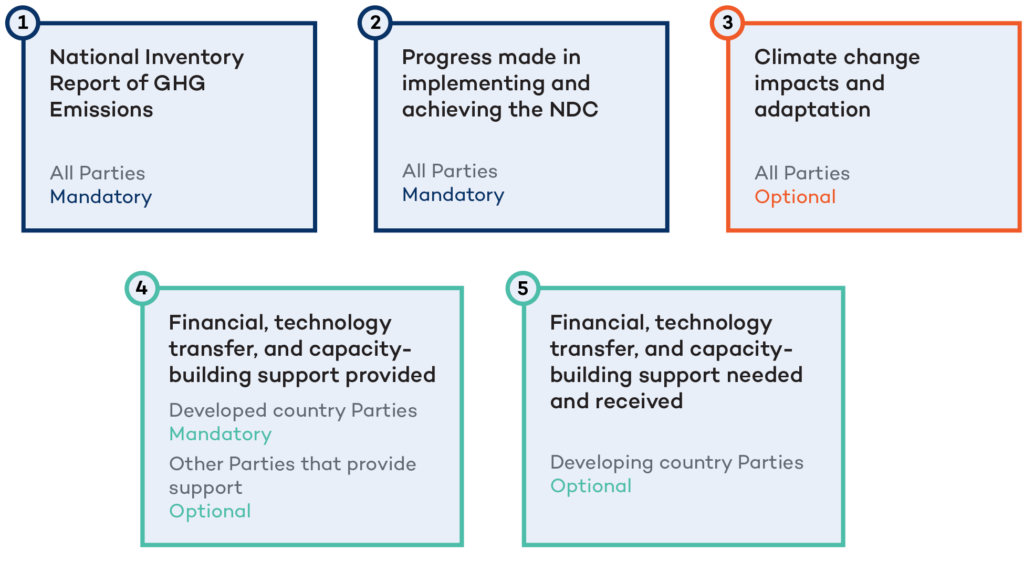
Figure 1. Different chapters and components of the BTR The BTR is the reporting vehicle for the ETF, complementing other communication and reporting vehicles under the UNFCCC and the Paris Agreement, such as the National Communications (NCs) and the Adaptation Communications (AdCom). The purpose of the ETF is to “build mutual trust and confidence and to promote effective implementation” through the transparent sharing of information between Parties. A common reporting format, like the BTR, allows comparability, consistency, and completeness of information provided while avoiding duplication of work and undue burden.
All Parties to the Paris Agreement are required to submit a BTR to report on their national climate information and their progress in climate action. However, including a chapter on climate change impacts and adaptation in BTRs is optional.
-
What Is the Purpose of BTRs?
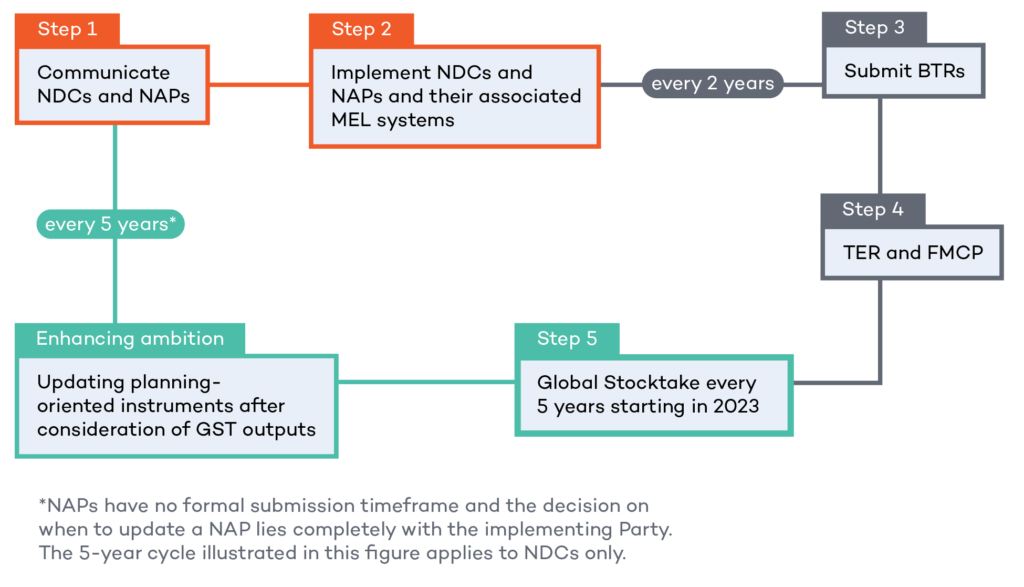
As the reporting instrument of the Paris Agreement, BTRs help facilitate mutual trust and confidence between countries and allow Parties and non-Party stakeholders to understand the state of climate action in each country. Regular and quality reporting of each country’s climate action and the progress they are making toward their commitments help demonstrate that countries are not tackling the climate crisis on their own. It also allows countries to exchange information and share lessons learned from their domestic climate actions.
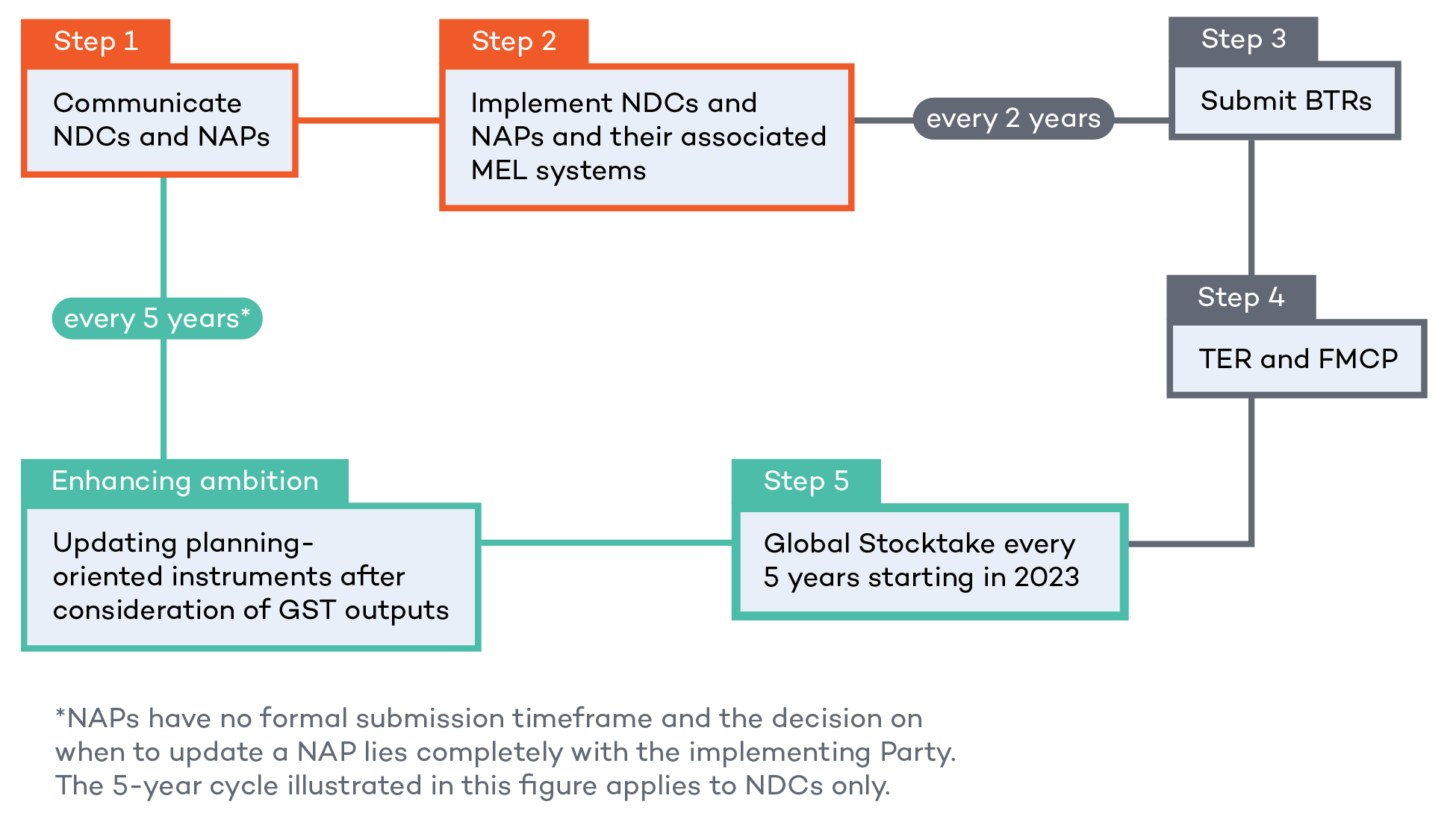
The Global Stocktake (GST) process also uses the BTRs as a key source of information to assess the overall collective progress made in achieving the long-term goals of the Paris Agreement. This input is based on information contained in the BTR documents themselves, as well as from the technical expert review (TER) and the facilitative, multilateral consideration of progress (FMCP) processes (see below). The TER is optional for reporting on adaptation in the BTR.
Both the review process under the ETF and the GST help identify data and information gaps that, if filled, would allow Parties to better understand and communicate progress in domestic climate action. Parties can also use this identification of gaps to strengthen their national monitoring, evaluation, and learning (MEL) systems so that subsequent BTRs (and other communication and reporting vehicles) are more comprehensive. This applies to MEL of adaptation, and, in fact, can be an important part of building MEL systems for adaptation, given how challenging and iterative such efforts are. Ultimately, the outputs of the GST then provide direction and insights to inform Parties in updating their national plans, such as Nationally Determined Contributions (NDCs) and NAPs, with a view to increasing ambition on climate action.
-
Are All Countries Required to Submit a BTR?
All Parties to the Paris Agreement, except for small island developing states (SIDS) and the least developed countries (LDCs), are required to provide country-specific information on the implementation of the Paris Agreement in the form of a BTR. Recognizing the capacity constraints faced by SIDS and LDCs, and the need to provide flexibility in light of their national circumstances, SIDS and LDCs may submit BTRs at their discretion.
-
What Is the Deadline for Submitting the First BTR?
All countries, except for SIDS and LDCs, are required to submit their first BTR (BTR1) by December 31, 2024, and every 2 years thereafter. The second BTR (BTR2) should be submitted by December 31, 2026.
-
Are Countries Required to Report on Adaptation in Their BTRs?
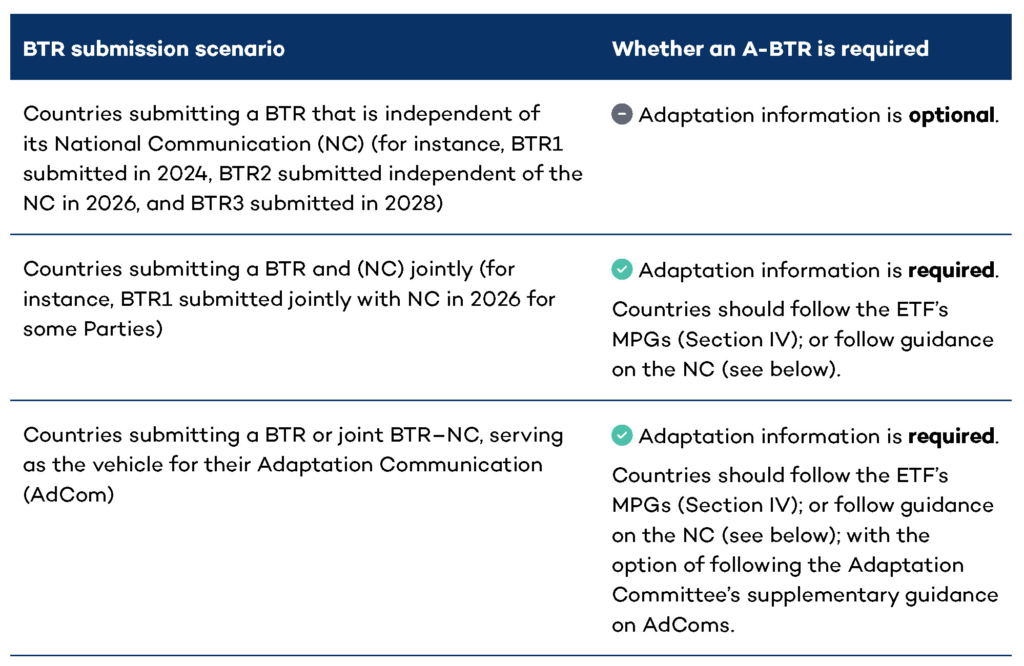
No. While submitting a BTR is mandatory, countries do not have to include the chapter on climate change impacts and adaptation information (A-BTR). Despite being optional, countries are encouraged to prepare the A-BTR to
• provide the necessary adaptation-related information for the GST’s assessment of the collective progress made toward achieving the Global Goal on Adaptation (GGA);
• facilitate the sharing of experiences and best practices related to adaptation;
• communicate adaptation-related financial, technological, and capacity needs;
• review and strengthen the relevance and effectiveness of the national MEL system for adaptation; and
• streamline the reporting arrangements for adaptation, including satisfying NC’s adaptation requirements and acting as a vehicle for AdComs (see below).
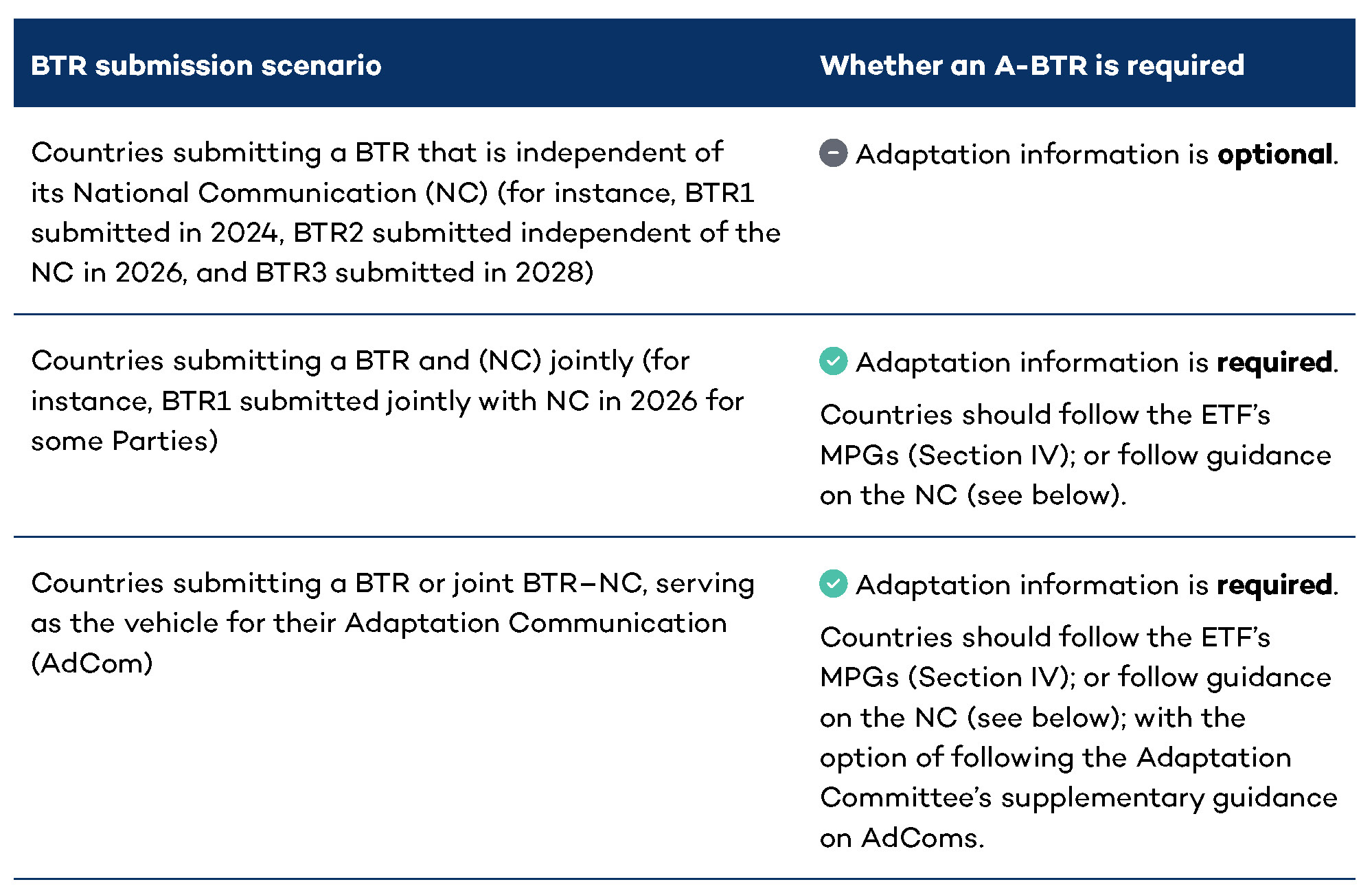
Recognizing the burden of preparing multiple reports and communications under the UNFCCC, countries may choose to streamline or combine efforts. For instance, countries can decide to submit their BTRs jointly as their NC when the reporting year for both overlaps. Similarly, Parties who choose to include adaptation in their BTRs may use it as the vehicle for their AdCom. See the table below on BTR, NC, and AdCom submissions. In line with Article 13, SIDS and LDCs may submit BTRs at their discretion.
-
What Are the Linkages Between A-BTR and NC?
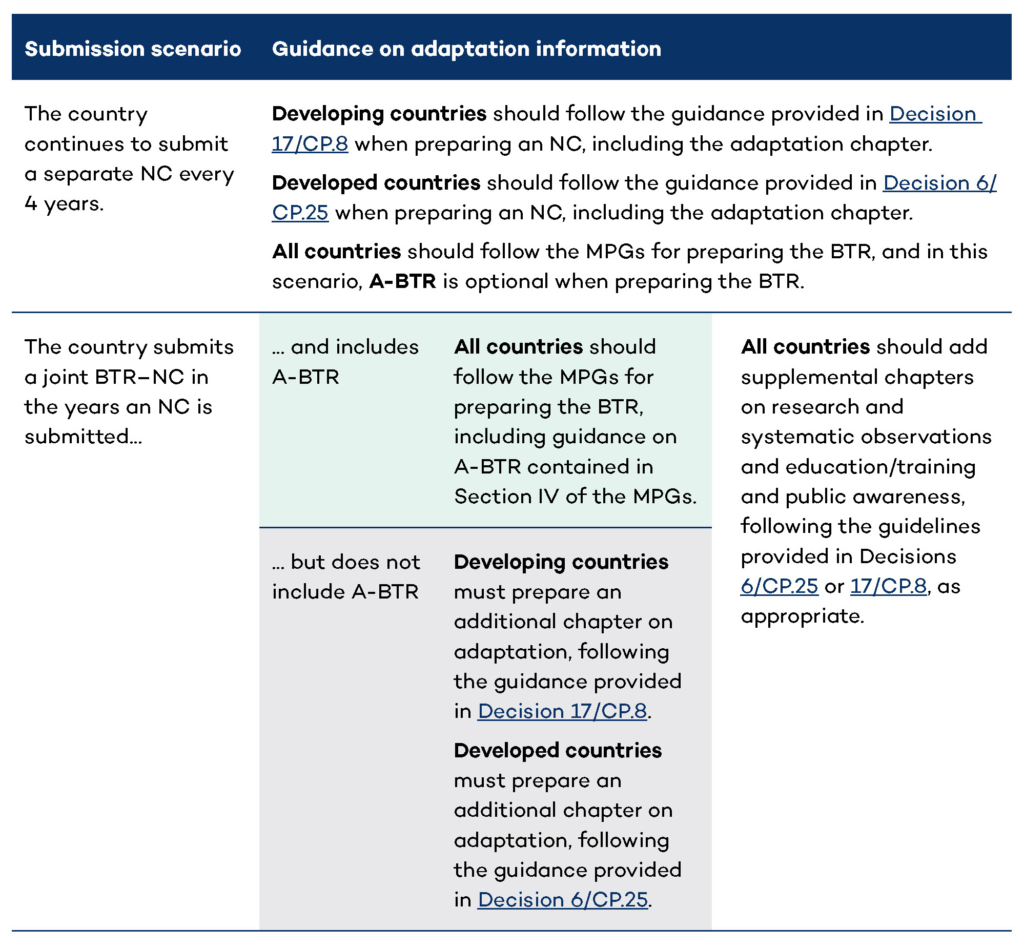
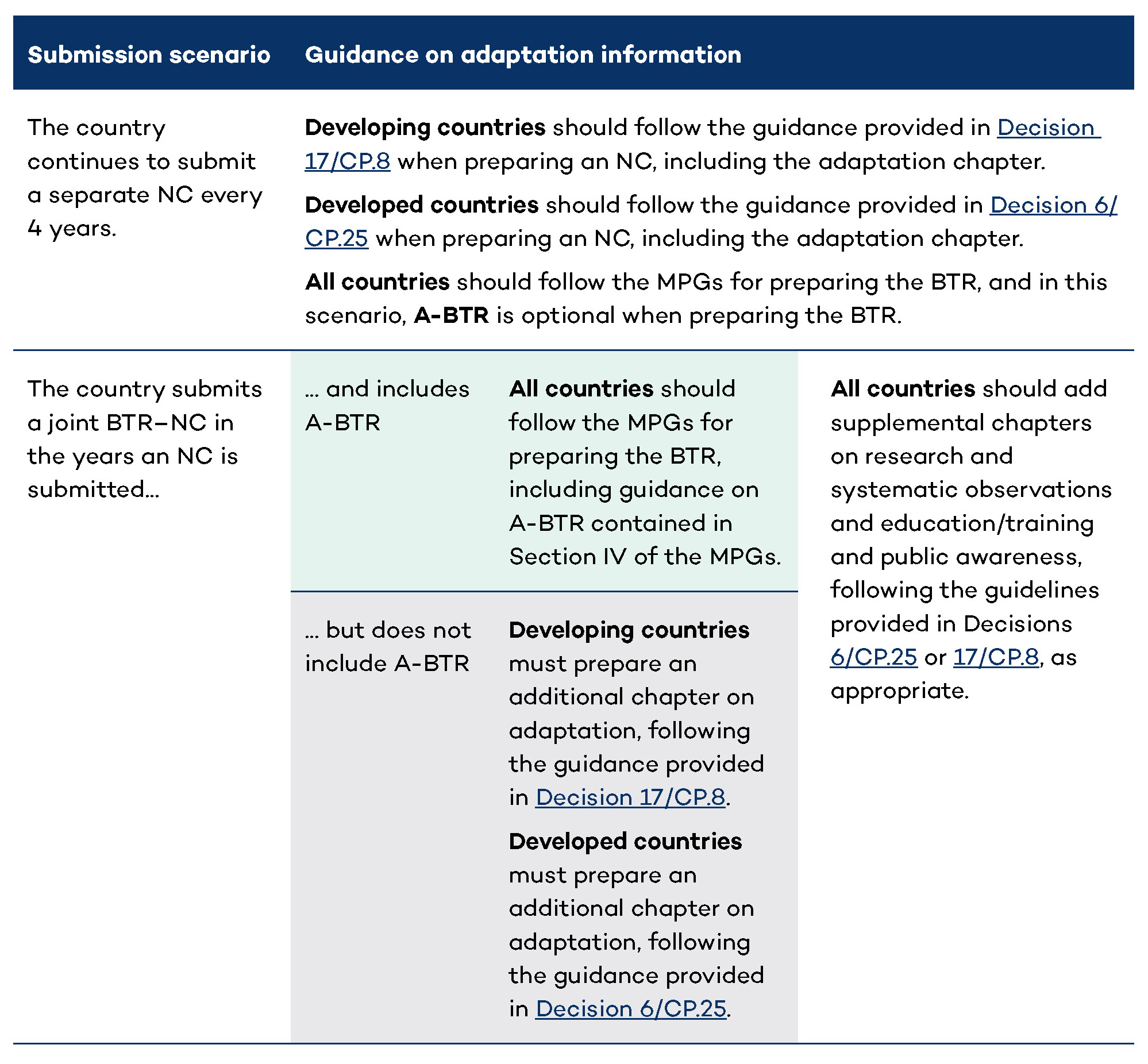
The NC is a reporting instrument under the UNFCCC. Developed countries are required to submit an NC every 4 years, and developing countries are strongly encouraged to submit an NC every 4 years.
BTR does not replace the NC. However, Parties will have the option of combining the BTR and NC in years when the two reporting instruments overlap (starting in 2026 for some Parties, and every 4 years thereafter). By submitting their BTRs and NCs jointly, countries could streamline their reporting obligations under the UNFCCC and avoid duplication of efforts, as well as reducing their reporting burdens, in light of the capacity constraints faced by many developing countries.
-
What Are the Linkages Between A-BTR and the AdCom?
The AdCom is a report prepared by countries that synthesizes and shares their priorities, efforts, needs, and lessons around adapting to climate change. An AdCom could be submitted by itself or “as a component of or in conjunction with other communications or documents,” including as part of the BTR through the preparation of the A-BTR. By using A-BTR as the vehicle for their AdCom, countries could streamline their reporting obligations under the UNFCCC and avoid duplication of efforts, as well as reducing their reporting burdens, in light of the capacity constraints faced by many developing countries.
There is no mandatory submission schedule for AdComs, noting that countries were encouraged to submit their first one to provide timely inputs into the GST process. Therefore, Parties may choose their own schedule for submitting an AdCom or use the schedule of other reporting vehicles; for example, if the country chooses to use its A-BTR as the vehicle for its AdCom, it will follow the reporting schedule of the BTR.
The NAP Global Network has also produced an FAQ on AdComs and a report on how to leverage the NAP process to prepare AdComs. The Adaptation Committee has also produced a supplementary guidance for voluntary use by Parties in communicating information in accordance with the possible elements of an adaptation communication.
-
What Is the Voluntary Review Process for A-BTR?
As per the Paris Agreement, most chapters of the BTRs will be reviewed through a TER process, except for the adaptation chapters.
However, many Parties have highlighted the important role that A-BTR reviews could play in facilitating the sharing of experiences and best practices related to adaptation and the gradual improvements in adaptation reporting. In 2022, Parties adopted Decision 9/CMA.4, which allows any Party to request that the UNFCCC Secretariat organize a voluntary review of the A-BTR upon a Party’s request. The review will include
• a review of whether the A-BTR is prepared in accordance with the MPGs and
• identification of areas of improvement and capacity-building needs related to A-BTR reporting, in consultation with the Party.
A Party may choose to subject the entirety of the A-BTR to the voluntary review or specify specific sections of the A-BTR for review.
-
What Is the Facilitative, Multilateral Consideration of Progress (FMCP) Process?
The FMCP process provides a public opportunity for Parties to showcase their mitigation and adaptation activities reported in the BTRs, as well as the support provided, mobilized, needed, and received. It involves a presentation and a questions and answers segment where questions may be submitted by other Parties. The goal of the FMCP process is to promote transparency and provide an opportunity for relevant stakeholders to understand Parties’ efforts and offer feedback on whether any “course correction” is needed. Although A-BTR is not explicitly a focus of FMCP, Parties may nevertheless choose to present on their A-BTRs. The FMCP replaces the previous Multilateral Assessment for developed countries and Facilitative Sharing of Views for developing countries.
CONTENT
-
What Information Should Be Included in an A-BTR?
The A-BTR is optional for countries to include in their BTRs, unless they wish to submit a joint BTR–NC or use the A-BTR as their AdCom. If a country wishes to prepare one, Chapter IV of the MPGs outlines the information Parties should provide in their A-BTRs (see table below). Parties are encouraged to follow the outline, but it is not mandatory.
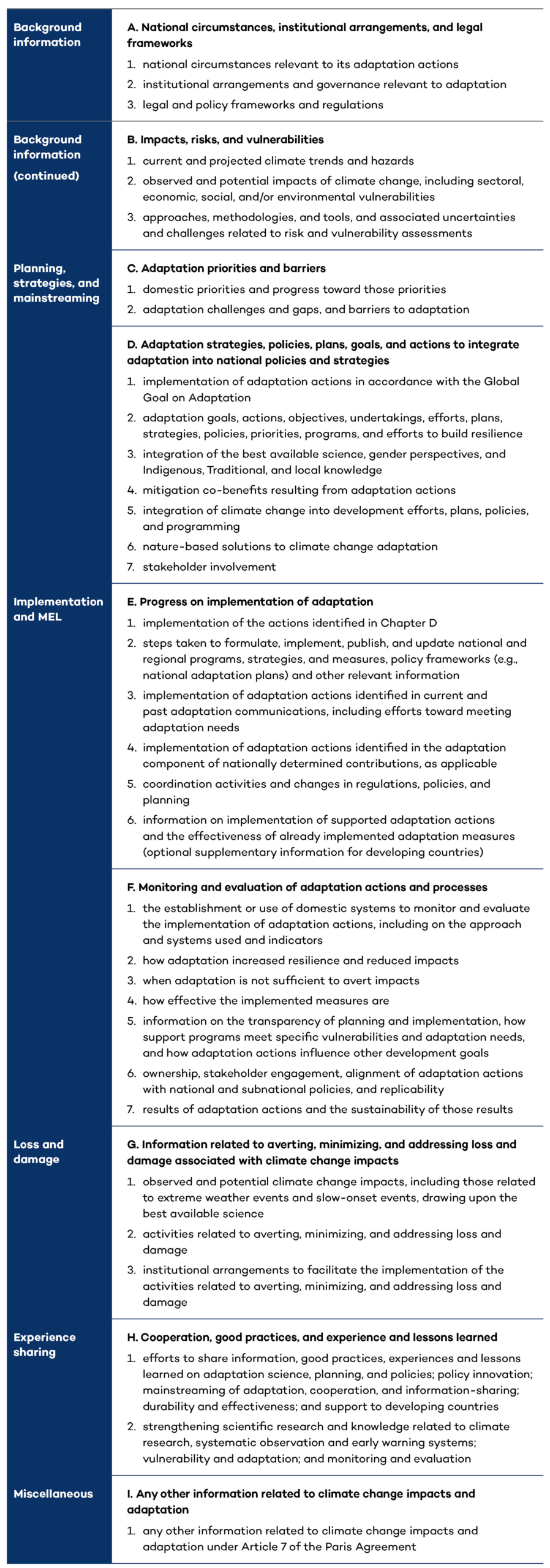
What Information Should Be Included in an A-BTR? -
Can Countries Cross-Reference to Other Documents?
Yes. The MPGs state that:
When reporting information related to climate change impacts and adaptation … a Party may cross-reference previously reported information and focus its reporting on updates to previous reported information.
Countries may cross-reference their NAPs, AdComs, previous NCs, and other adaptation-related planning or reporting instruments without repeating what has already been reported in the A-BTR and help countries align the A-BTR with existing documents. For instance, if a Party chooses to cross-reference its NAP’s vulnerability and risk assessment section, they may indicate in their BTR under Section B (Impacts, Risks, and Vulnerabilities) to “refer to Section X of the NAP.”
This provision effectively avoids the duplication of work and placing undue burdens on countries and the Secretariat. However, countries that wish to include new information or report an update to their previously reported information are free to do so.
-
What Guidance Exists on Developing an A-BTR?
The UNFCCC has prepared a comprehensive Reference Manual for the ETF, where it lays out everything practitioners and negotiators need to know about the ETF and its linkages with other UNFCCC processes.
In 2020, the Initiative for Climate Action Transparency developed specific guidance on how to report adaptation through the BTR. It poses a series of guiding questions to help decipher the requirements of the BTR and support countries in preparing their A-BTRs.
In March 2023, the Consultative Group of Experts further developed training material on Reporting Information Related to Climate Change Impacts and Adaptation that can inform countries in preparing their BTRs.
LEVERAGING THE NAP PROCESS
-
How Could Countries Leverage Their NAP Processes for Developing an A-BTR?
NAP documents are likely to contain information that is relevant to developing an A-BTR, especially for Sections A–D of the A-BTR.
These include national circumstances, institutional arrangements, and legal frameworks for adaptation; impacts, risks, and vulnerabilities; adaptation priorities and barriers; and adaptation strategies, policies, plans, goals, and actions to integrate adaptation into national policies and strategies. Some countries have developed, or are in the process of developing, MEL systems for their NAPs, which may inform Section F of the A-BTR on information related to the monitoring and evaluation of adaptation actions and processes. Some NAPs may also include information relevant to averting, minimizing, and addressing loss and damage associated with climate change impacts, which could be useful when preparing Section G of the A-BTR.
The information contained within a NAP can be cross-referenced in the A-BTR or distilled into shorter and more focused summaries. Reviewing the draft or the final version of a NAP could be a useful starting point when developing an A-BTR.
For countries that are planning to report on their NAP’s implementation, or have already prepared a NAP progress report, they may use this information to inform their A-BTR’s Sections E and H on the progress of adaptation actions’ implementation and good practices, experiences, and lessons learned.
Countries may also wish to submit their A-BTR as their AdCom, or conversely, use the AdCom they have already developed as a basis for their A-BTR, to avoid duplication of effort. The following table illustrates the synergies in information requirements between the different adaptation-related reporting vehicles under the UNFCCC and the Paris Agreement.
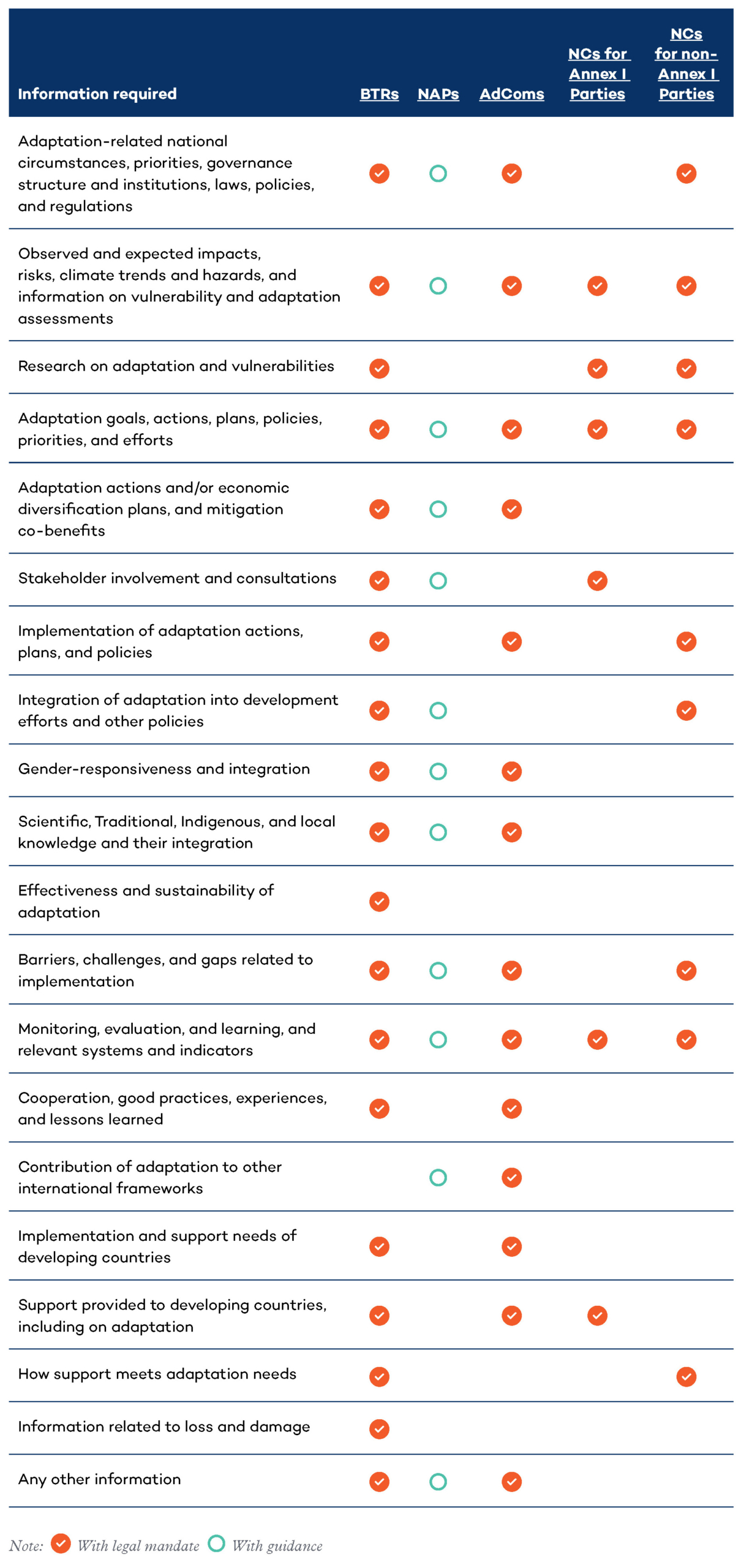
-
What Can Be Done For a Country That Has Not Completed a NAP Document but Has a NAP Process Underway?
Many countries are currently working on their NAP documents or may not have formally submitted their NAP documents to the UNFCCC. The UNFCCC reported in 2022 that 139 developing countries have NAP processes underway.
Countries in this situation may nonetheless have advanced some NAP processes that can help inform BTRs. Drawing on what they have done so far in their NAP process—whether it is a NAP Framework, roadmap, climate risk assessments, design of a MEL framework, or other milestones along the way—countries can use and synthesize whatever information they have available from the NAP process in their BTR.